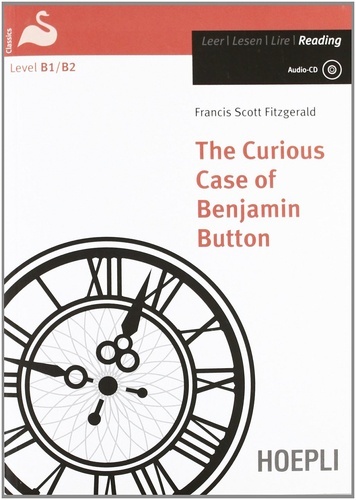
Editorial Hoepli
Colección Leggere, Número 0
Lugar de edición
Milano, Italia
Fecha de edición julio 2012 · Edición nº 1
Idioma inglés
EAN 9788820350437
56 páginas
Libro
encuadernado en tapa blanda
Dimensiones 150 mm x 210 mm
Benjamin Button was born under most unusual circumstances. At the ripe old age of seventy with a long smoke-coloured beard he found himself uncomfortably squashed into a hospital crib yearning for a cigar rather than warm milk. As the world moved forward he lived his life in reverse becoming younger and stronger much to the embarrassment of his family. The reader is carried dramatically through the various stages of his eventful existence as he goes to war, enters the business world, falls in love, has a son, goes to college and eventually slides back into babyhood. Although written in the 1920s, the story is still relevant today mirroring our obsession with age and appearance and ridiculing the social norms that condition our lives. This strange and haunting fable is written in the evocative and carefully constructed prose that made Fitzgerald one of the memorable voices in American literature.
In 2008 the story was made into a successful film by David Fincher starring Brad Pitt and Cate Blanchett.
This volume is accompanied by notes and a wide range of learning activities to enable readers to enrich their vocabulary and practise language structures.
Francis Scott Fitzgerald (1896 1940) fue uno de los escritores más influyentes de la literatura estadounidense del siglo XX. Formado en Princeton, orientó su vida hacia la creación literaria tras un breve período en el ejército durante la Primera Guerra Mundial. Con A este lado del paraíso (1920) inició una carrera fulgurante que lo convirtió en el principal cronista de la Era del jazz . Autor de obras emblemáticas como El gran Gatsby, Hermosos y malditos y Suave es la noche, exploró con extraordinaria lucidez las tensiones entre deseo, clase social y desengaño en la modernidad norteamericana. Su estilo preciso y elegante, unido a una sensibilidad única para captar el espíritu de su tiempo, lo ha consagrado como una figura central en el canon literario contemporáneo.
|
||||||