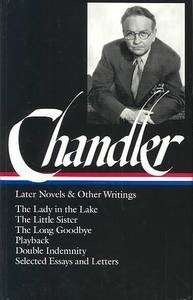
With humor, along with an unerring sense of dialogue and the telling details of dress and behavior, Raymond Chandler created a distinctive fictional universe out of the dark side of sunlit Los Angeles. In the process, he transformed both crime writing and the American language. br br Written during the war, The Lady in the Lake (1943) takes Philip Marlowe out of the seamy L.A. streets to the deceptive tranquility of the surrounding mountains, as the search for a businessman's missing wife expands into an elegy of loneliness and loss. The darker tone typical of Chandler's later fiction is evident in The Little Sister (1949), in which an ambitious starlet, a blackmailer, and a seemingly na ve young woman from Manhattan, Kansas, are the key players in a plot that provides fuel for a bitter indictment of Hollywood and Chandler's most savage portrayal of his adopted city. br br The Long Goodbye (1953), his most ambitious and self-revealing novel, uncovers a more anguished resonance in the Marlowe character, in a plot that hinges on the betrayal of friendship and the compromises of middle age. Playback (1958), written originally as a screenplay, is Chandler's seventh and last novel. br br A special feature of this volume is Chandler's long-unavailable screenplay for the film noir classic, Double Indemnity (1944), adapted from James M. Cain's novel. Written with director Billy Wilder, it is one of the best screenplays in American cinema, masterful in construction and dialogue. Supplementing the volume, and providing a more personal glimpse of Chandler's personality, is a selection of letters and essays including "The Simple Art of Murder," in which Chandler muses on his pulp roots and on the special qualities of his hero and style. br br
x{0026}lt;P x{0026}lt;B Raymond Thornton Chandlerx{0026}lt;/B (1888-1959) es el gran maestro de la novela negra americana. Nació en Chicago, pero pasó la mayor parte de su infancia y juventud en Inglaterra, donde estudió en el Dulwich College y acabó trabajando como periodista x{0026}lt;I freelance x{0026}lt;/I en x{0026}lt;I The Westminster Gazettex{0026}lt;/I y x{0026}lt;I The Spectatorx{0026}lt;/I . Durante la Primera Guerra Mundial, se alistó en la Primera División Canadiense, que servía en Francia, y más adelante entró a formar parte de la Royal Air Force (RAF). En 1919 regresó a Estados Unidos y se instaló en California, donde ejerció como directivo de varias compañías petroleras independientes. Sin embargo, la Gran Depresión terminó con su carrera en dicho sector en 1933.x{0026}lt;/P x{0026}lt;P Chandler tenía cuarenta y cinco años cuando empezó a escribir relatos detectivescos para revistas baratas de género negro, más conocidas como pulps: x{0026}lt;I Black Maskx{0026}lt;/I y x{0026}lt;I Dime Detectivex{0026}lt;/I . Sus novelas destacan por el realismo duro y la mirada social crítica. En x{0026}lt;I El sueño eternox{0026}lt;/I (1939), su primera novela, presentó en sociedad al impetuoso pero noble Philip Marlowe. Pronto la siguieron x{0026}lt;I Adiós, muñecax{0026}lt;/I (1940), x{0026}lt;I La ventana altax{0026}lt;/I (1942), x{0026}lt;I La dama del lagox{0026}lt;/I (1943), x{0026}lt;I La hermana menorx{0026}lt;/I (1949), x{0026}lt;I El largo adiósx{0026}lt;/I (1953) y x{0026}lt;I Playback x{0026}lt;/I (1958).x{0026}lt;/P x{0026}lt;P Mantuvo una relación estrecha y turbulenta con Hollywood, que llevó sus novelas a la gran pantalla y para cuya industria cinematográfica trabajó de guionista entre 1943 y 1950. En 1958 fue elegido presidente de la organización Mystery Writers of America. Murió en La Jolla, California, el 26 de marzo de 1959.x{0026}lt;/P
|
||||||