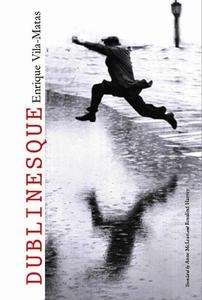
Dublinesque
Editorial Norton
Fecha de edición junio 2012
Idioma inglés
EAN 9780811219617
320 páginas
Libro
encuadernado en tapa blanda

Resumen del libro
In this novel, Enrique Vila-Matas traces a journey connecting the worlds of Joyce and Beckett, and all they symbolize.
One night, a renowned and now retired literary publisher has a vivid dream that takes place in Dublin, a city he never visited. The central scene of the dream is a funeral in the era of Ulysses. The publisher would give anything to know if an unidentified character in his dream is the great author he always wanted to meet, or the ghostly angel who abandoned him during childhood. As the days go by, he will come to understand that his vision of the end of an era was prophetic.
Enrique Vila-Matas traces a journey that connects the worlds of Joyce and Beckett, revealing the difficulties faced by literary authors, publishers, and good readers in a society where literature is losing influence. A robust work, Dublinesque is a masterwork of irony, humor, and erudition by one of Spain most celebrated living authors.
Anne McLean has won the Independent Foreign Fiction Prize twice, as well as the Premio Valle Incla-n. She has translated the works of Javier Cercas, Julio Cort-zar, Carmen Mart-n Gaite, Ignacio Padilla, and Evelio Rosero. Enrique Vila-Matas was born in Barcelona in 1948. His novels have been translated into eleven languages and honored by many prestigious literary awards including the Prix M-dicis Etranger. Author of Bartleby x{0026} Co., Montano Malady, and Never Any End to Paris, he has received Europe most prestigious awards and been translated into twenty-seven languages.
Rosalind Harvey is translator in residence at London's Free Word Centre. Her translation of Juan Villalobo's Down the Rabbit Hole was longlisted for the Guardian First Book Award.
-Mr. Vila-Matas shows that the reasons for (and the consequences of) not writing fiction can, in a funny way, be almost as rich and complicated as fiction itself.- - The Economist
-Perfect. Beautiful. Wistful. There is no hint of irony in these words of praise for Bartleby x{0026} Co.- - The Los Angeles Times
Biografía del autor
P Enrique Vila-Matas (Barcelona, 1948) es uno de los más destacados escritores europeos del momento y su obra ha sido traducida a 32 idiomas. Sus libros transitan con éxito por diferentes géneros, en los que siempre quedan patentes su estilo singular y su indisociable universo narrativo. De su trayectoria narrativa destacan En un lugar solitario (1973), La asesina ilustrada (1977), Nunca voy al cine (1982), Impostura (1984), Historia abreviada de la literatura portátil (1985), Una casa para siempre (1986), Suicidios ejemplares (1988), Hijos sin hijos (1993), Recuerdos inventados (1994), Lejos de Veracruz (1995), Extraña forma de vida (1997), El viaje vertical (1999), Bartleby y compañía (2000), El mal de Montano (2002), París no se acaba nunca (2004), Doctor Pasavento (2005), Exploradores del abismo (2007), Dietario Voluble (2008), Dublinesca (2010), Chet Baker piensa en su arte (2011) y Aire de Dylan (2012). Entre sus libros de ensayos literarios encontramos El viajero más lento (1992, 2011), El traje de los domingos (1995), Para acabar con los números redondos (1997), Desde la ciudad nerviosa (2000), Aunque no entendamos nada (2003), El viento ligero en Parma (2004), Y Pasavento ya no estaba (2007), Perder teorías (2010) y Una vida absolutamente maravillosa (2011). Ha obtenido, entre otros galardones, el Premio Ciudad de Barcelona, el Premio Rómulo Gallegos, el Prix Paris Au Meilleur Livre Étranger (2001), el Premio Herralde (2002), el Premio Nacional de la Crítica en España, el Prix Fernando Aguirre-Libralire, el Prix Médicis-Étranger (2003), el Internazionale Ennio Flaiano (2005), el Premio de la Real Academia Española (2006), el Premio Fundación Lara (2006), el Premio Elsa Morante (2007), el Internazionale Mondello (2009), el Premio Bottari Lattes Grinzane (2011) y el Premio FIL 2015. En 2010 recibió el X Premio Leteo por su "contribución a la innovación literaria" y en 2011, por su novela Dublinesca, recibió el segundo Prix Jean Carrière. Es "Chevalier" de la Legión de Honor francesa y pertenece a la irlandesa Orden de los Caballeros del Finnegans, en cuyo escudo reza el lema extraído de la última frase del sexto capítulo de Ulises, de Joyce: "Gracias. ¡Qué grandes estamos esta mañana!".<br>