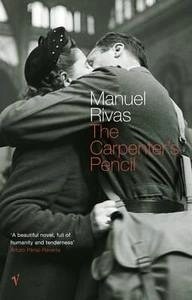
Editorial Vintage UK
Fecha de edición enero 2003
Idioma inglés
EAN 9780099448464
176 páginas
Libro
encuadernado en tapa blanda
It is the summer of 1936, the early months of the agonising civil war that engulfs Spain and shakes the rest of the world. In a prison in the pilgrim city of Santiago de Compostela, an artist sketches the famous porch of the cathedral, the Pórtico da Gloria. He uses a carpenter's pencil. But instead of reproducing the sculptured faces of the prophets and elders, he draws the faces of his fellow Republican prisoners.
Many years later in post-Franco Spain, a survivor of that period, Doctor Daniel da Barca, returns from exile to his native Galicia, and the threads of past memories begin to be woven together. This poetic and moving novel conveys the horror and savagery of the tragedy that divided Spain, and the experiences of the men and women who lived through ti. Yet in the process, it also relates one of the most beautiful love stories imaginable.
x{0026}lt;P x{0026}lt;B Manuel Rivasx{0026}lt;/B nació en A Coruña. Desde muy joven trabajó en prensa y sus reportajes y artículos están reunidos en Ex{0026}lt;I l periodismo es un cuento x{0026}lt;/I (1997 y 2015), x{0026}lt;I Mujer en el bañox{0026}lt;/I (2003) y x{0026}lt;I A cuerpo abiertox{0026}lt;/I (2008). En su extensa obra narrativa, que incluye novelas y libros de relatos, destacan los títulos x{0026}lt;I Un millón de vacasx{0026}lt;/I (1990, Premio de la Crítica de narrativa gallega), x{0026}lt;I En salvaje compañíax{0026}lt;/I (1994, Premio de la Crítica de Galicia), x{0026}lt;I ¿Qué me quieres, amor? x{0026}lt;/I (1996, Premio Nacional de Narrativa, Premio Torrente Ballester), x{0026}lt;I El lápiz del carpinterox{0026}lt;/I (1998, Premio de la Crítica, Premio Arzobispo Juan de San Clemente), x{0026}lt;I Los libros arden malx{0026}lt;/I (2006, Premio de la Crítica, Premio de la Crítica de Galicia, Libro del Año del Gremio de Libreros de Madrid), x{0026}lt;I Todo es silenciox{0026}lt;/I (2010, finalista del Premio Dashiell Hammett), x{0026}lt;I Lo más extraño x{0026}lt;/I (2012), x{0026}lt;I El último día de Terranovax{0026}lt;/I (2015, Premio de la Crítica), x{0026}lt;I Vivir sin permiso y otras historias de Oestex{0026}lt;/I (2018), x{0026}lt;I La tierra ocultax{0026}lt;/I (2023) y x{0026}lt;I Detrás del cielox{0026}lt;/I (2024). Algunas muestras de su amplia creación poética son x{0026}lt;I El pueblo de la nochex{0026}lt;/I (1997), x{0026}lt;I La desaparición de la nievex{0026}lt;/I (2009), x{0026}lt;I La boca de la tierrax{0026}lt;/I (2016) y x{0026}lt;I Lo que queda fuerax{0026}lt;/I (2023, Premio de la Crítica de Galicia). También es autor de la narración autobiográfica x{0026}lt;I Las voces bajasx{0026}lt;/I (2012) y de los ensayos eco-literarios x{0026}lt;I Contra todo esto. Un manifiesto rebeldex{0026}lt;/I (2018) y x{0026}lt;I Zona a defenderx{0026}lt;/I (2020). En 2022 recibió la Medalla de Oro al Mérito en las Bellas Artes, y en 2024 fue galardonado con el Premio Nacional de las Letras Españolas.x{0026}lt;/P
|
||||||