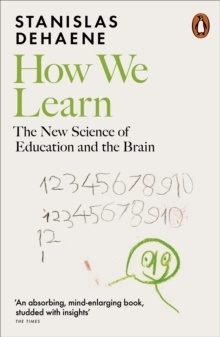
Absorbing, mind-enlarging, studded with insights ... This could have significant real-world results' Sunday TimesHumanity's greatest feat is our incredible ability to learn. Even in their first year, infants acquire language, visual and social knowledge at a rate that surpasses the best supercomputers.
But how, exactly, do our brains learn?In How We Learn, leading neuroscientist Stanislas Dehaene delves into the psychological, neuronal, synaptic and molecular mechanisms of learning. Drawing on case studies of children who learned despite huge difficulty and trauma, he explains why youth is such a sensitive period, during which brain plasticity is maximal, but also assures us that our abilities continue into adulthood. We can all enhance our learning and memory at any age and 'learn to learn' by taking maximal advantage of the four pillars of the brain's learning algorithm: attention, active engagement, error feedback and consolidation.
The human brain is an extraordinary machine. Its ability to process information and adapt to circumstances by reprogramming itself is unparalleled, and it remains the best source of inspiration for recent developments in artificial intelligence. How We Learn finds the boundary of computer science, neurobiology, cognitive psychology and education to explain how learning really works and how to make the best use of the brain's learning algorithms - and even improve them - in our schools and universities as well as in everyday life.
 Cerrar



 Volver