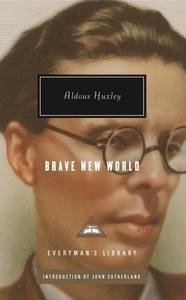
Editorial Everyman's Library
Fecha de edición septiembre 2013 · Edición nº 1
Idioma inglés
EAN 9781841593593
280 páginas
Libro
encuadernado en tapa dura
A towering classic of dystopian satire, BRAVE NEW WORLD is a brilliant and terrifying vision of a soulless society-and of one man who discovers the human costs of mindless conformity.
Hundreds of years in the future, the World Controllers have created an ideal civilization. Its members, shaped by genetic engineering and behavioral conditioning, are productive and content in roles they have been assigned at conception. Government-sanctioned drugs and recreational sex ensure that everyone is a happy, unquestioning consumer; messy emotions have been anesthetized and private attachments are considered obscene. Only Bernard Marx is discontented, developing an unnatural desire for solitude and a distaste for compulsory promiscuity. When he brings back a young man from one of the few remaining Savage Reservations, where the old unenlightened ways still continue, he unleashes a dramatic clash of cultures that will force him to consider whether freedom, dignity, and individuality are worth suffering for.
Aldous Huxley's ingenious fantasy of a future of mechanical efficiency and engineered harmony has been enormously influential for generations, and is as provocative, powerful, and riveting as when it was first published in 1932.
x{0026}lt;P x{0026}lt;B Aldous Huxleyx{0026}lt;/B (1894-1963), novelista, ensayista, crítico y poeta inglés, nieto de Thomas y hermano de Julian, ambos científicos de renombre. Nació en Godalming, Surrey, y estudió en el colegio Eton y la universidad de Oxford. Trabajó en varios periódicos y publicó cuatro libros de poesía antes de la aparición de su primera novela, x{0026}lt;I Los escándalos de Cromex{0026}lt;/I (1921). Las novelas x{0026}lt;I Heno antiguox{0026}lt;/I (1923) y x{0026}lt;I Contrapunto x{0026}lt;/I (1928), que ilustran el ambiente nihilista de la década de 1920, y x{0026}lt;I Un mundo felizx{0026}lt;/I (1932), una visión deshumanizada y utópica del futuro, le hicieron famoso. Durante gran parte de esta época vivió en Italia y Francia. En 1937 emigró a Estados Unidos. Entre sus más de 45 libros destacan los de ensayo, x{0026}lt;I Un Pilatos burlónx{0026}lt;/I (1926), x{0026}lt;I Mañana y mañana y mañanax{0026}lt;/I (1956), x{0026}lt;I Nueva visita a un mundo felizx{0026}lt;/I (1958) y x{0026}lt;I Literatura y cienciax{0026}lt;/I (1963). Otras novelas son x{0026}lt;I Ciego en Gazax{0026}lt;/I (1936), x{0026}lt;I Viejo muere el cisnex{0026}lt;/I (1939), x{0026}lt;I Mono y esencia x{0026}lt;/I (1948) y x{0026}lt;I La islax{0026}lt;/I (1962). Huxley también escribió crítica científica, filosófica y social, con obras importantes como x{0026}lt;I El arte de verx{0026}lt;/I (1932), x{0026}lt;I La filosofía perennex{0026}lt;/I (1946) y x{0026}lt;I Los demonios de Loudonx{0026}lt;/I (1952). Se interesó mucho por el misticismo y la parapsicología. x{0026}lt;I Las puertas de la percepciónx{0026}lt;/I (1954) y su continuación, x{0026}lt;I Cielo e infiernox{0026}lt;/I (1956), tratan de sus experiencias con drogas alucinógenas.x{0026}lt;/P
|
||||||